SITE FEATURES


SPONSORS

FRIENDS






LATEST NEWS
Is This Scene in TLJ Plausible?
Thanks to this article from Wired, this burning question has been tackled by some outstanding nerds.
Apparently, the way to look at the problem is by calculating the Star Destroyer's angular size. What's angular size, you ask?
Got it? Based on actual distance and size, angular distance is essentially the amount of "degrees" (or radians) occupied by a distant object in your field of view. The author cites a Wikipedia entry stating that the "naked eye" can see anything that has an angular size of 0.02 degrees (assuming the view is unobstructed)
Basically, the max distance at which humans can see is theoretically infinite. Humans can see any object as long as it is large enough, emits or reflects enough light, and which has an unobstructed view.
The author makes some simple calculations based on the over-the-shoulder shot of Lt. Connix viewing the arrival of two First Order Star Destroyers above the skies of D'Qar during the Resistance evacuation in The Last Jedi. The calculations put the angular size of the Star Destroyers at around 0.4, which is far larger than the estimated 0.02 necessary to see with the naked eye.
So it would seem the shot is plausible enough. Now you can get a good night's rest.

UPDATE:
Added this deleted scene from ANH, in which Luke apparently needs binoculars to see The Devastator attacking the Tantive IV:
According to Wookieepedia, the Devastator was only about half the length of the FO Resurgent-class star destroyers, and maybe it was further away from the Tatooine surface.
comments powered by Disqus
Apparently, the way to look at the problem is by calculating the Star Destroyer's angular size. What's angular size, you ask?
You can calculate the angular size as just the object size divided by the distance (in radians). If you want to convert to degrees, you need to also multiply by 180 and divide by π.
Got it? Based on actual distance and size, angular distance is essentially the amount of "degrees" (or radians) occupied by a distant object in your field of view. The author cites a Wikipedia entry stating that the "naked eye" can see anything that has an angular size of 0.02 degrees (assuming the view is unobstructed)
Basically, the max distance at which humans can see is theoretically infinite. Humans can see any object as long as it is large enough, emits or reflects enough light, and which has an unobstructed view.
The author makes some simple calculations based on the over-the-shoulder shot of Lt. Connix viewing the arrival of two First Order Star Destroyers above the skies of D'Qar during the Resistance evacuation in The Last Jedi. The calculations put the angular size of the Star Destroyers at around 0.4, which is far larger than the estimated 0.02 necessary to see with the naked eye.
So it would seem the shot is plausible enough. Now you can get a good night's rest.
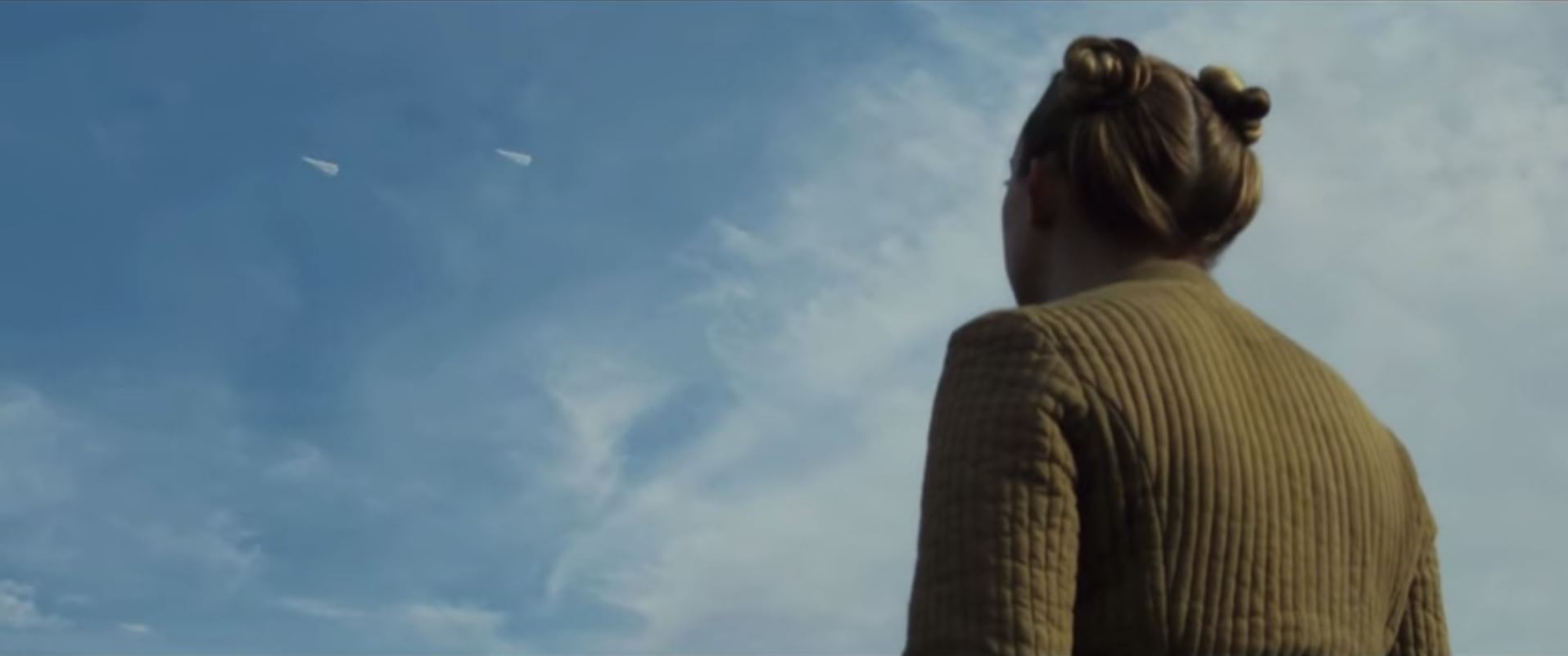
Lt. Connix wonders if this is even possible. Yes. Yes it is. Now get outta there!
UPDATE:
Added this deleted scene from ANH, in which Luke apparently needs binoculars to see The Devastator attacking the Tantive IV:
According to Wookieepedia, the Devastator was only about half the length of the FO Resurgent-class star destroyers, and maybe it was further away from the Tatooine surface.
comments powered by Disqus
LATEST PHOTO GALLERIES
VC - Orray & Geonosian Picador

VC - Super Battle Droid & Battle Droids (Geonosis)

VC397 - Baze Malbus

VC394 - Imperial Snowtrooper Commander

VC - Obi-Wan Kenobi (Utapau) & Airborne Clone Trooper (212th Battalion)

VC392 - General Veers (AT-AT Commander)

VC - Imperial Remnant Stormtrooper

VC - Imperial Remnant AT-RT
VC386 - Marrok

VC387 - Imperial Remnant AT-AT Driver

ADDITIONAL REVIEWS IN THE
PHOTO GALLERIES
PHOTO GALLERIES