SITE FEATURES


SPONSORS

FRIENDS






LATEST NEWS
Lucasfilm and Disney All In on Virtual/Augmented Reality
Disney and Lucasfilm seem committed to making Star Wars as immersive and realistic an experience as is possible for fans across the spectrum (users, viewers, role-players, etc.). They are doing this by investing heavily in various forms of virtual reality (VR) and augmented reality (AR).
As a quick primer, here is the difference between VR and AR:
Virtual Reality is a CG simulation of a real-life environment, in an attempt to make the user feel like they are experiencing something in the real world. The experience is independent of the users actual environment, and is usually generated through a peripheral like goggles.
Augmented Reality layers CG images over the real-life environment, so that they enhance each other. The user feels like they are in their true environment, with the addition of graphics that alter what they experience. Pokémon Go is an example, in which the user is presented with creatures on their mobile device and are presented as CG overlays which appear to be a part of the real world.
We have posted news recently that Lucasfilm division ILMxLab is working on forms of Star Wars storytelling using augmented and virtual reality, in conjunction with film viewing and theme park experiences. The latter was expanded upon with the news that Disney is developing Galaxy's Edge, a Star Wars theme park to be opened in Disneyland and Disneyworld. Quickly upping the ante, was the announcement that Disneyworld would get a fully immersive Star Wars hotel, in which guests would be a participant in their own story in a Westworld-like experience. And to cap it off, Disney is partnering with Lenovo to develop augmented reality games.
But prior to all of these announcements most of us, without realizing, witnessed more augmented reality at work, in the making of many of the special effects shots for Rogue One.
In the video below, Lucasfilm's John Knoll is onstage Monday at Fortune’s Brainstorm Tech conference in Aspen, Colorado. He explains how they needed to develop a new kind of technology to assist Gareth Edwards' unorthodox directing techniques. Essentially, they created a virtual set, and affixed Edwards' iPad with motion tracking dots, so that the effects crew could "see" exactly what Edwards wanted by carefully tracking the angle of his iPad. They could then easily recreate the "camera" angle when generating the effects shots, and get exactly what Edwards imagined, without him having to explain everything. It allowed the crew to capture the director's shot style for all the CG effects, instead of attempting to replicate them second hand, and therefore matching that style to the practical camera shots Edwards took on real sets. It's perhaps a subtle technique that most of us might not notice, but it's yet another step that Disney and Lucasfilm are taking to ensure the Star Wars experience is as realistic and seamless as possible.
Check out the short video of Knoll talking about the AR camerawork for Rogue One.
comments powered by Disqus
As a quick primer, here is the difference between VR and AR:
Virtual Reality is a CG simulation of a real-life environment, in an attempt to make the user feel like they are experiencing something in the real world. The experience is independent of the users actual environment, and is usually generated through a peripheral like goggles.
Augmented Reality layers CG images over the real-life environment, so that they enhance each other. The user feels like they are in their true environment, with the addition of graphics that alter what they experience. Pokémon Go is an example, in which the user is presented with creatures on their mobile device and are presented as CG overlays which appear to be a part of the real world.
We have posted news recently that Lucasfilm division ILMxLab is working on forms of Star Wars storytelling using augmented and virtual reality, in conjunction with film viewing and theme park experiences. The latter was expanded upon with the news that Disney is developing Galaxy's Edge, a Star Wars theme park to be opened in Disneyland and Disneyworld. Quickly upping the ante, was the announcement that Disneyworld would get a fully immersive Star Wars hotel, in which guests would be a participant in their own story in a Westworld-like experience. And to cap it off, Disney is partnering with Lenovo to develop augmented reality games.
But prior to all of these announcements most of us, without realizing, witnessed more augmented reality at work, in the making of many of the special effects shots for Rogue One.
In the video below, Lucasfilm's John Knoll is onstage Monday at Fortune’s Brainstorm Tech conference in Aspen, Colorado. He explains how they needed to develop a new kind of technology to assist Gareth Edwards' unorthodox directing techniques. Essentially, they created a virtual set, and affixed Edwards' iPad with motion tracking dots, so that the effects crew could "see" exactly what Edwards wanted by carefully tracking the angle of his iPad. They could then easily recreate the "camera" angle when generating the effects shots, and get exactly what Edwards imagined, without him having to explain everything. It allowed the crew to capture the director's shot style for all the CG effects, instead of attempting to replicate them second hand, and therefore matching that style to the practical camera shots Edwards took on real sets. It's perhaps a subtle technique that most of us might not notice, but it's yet another step that Disney and Lucasfilm are taking to ensure the Star Wars experience is as realistic and seamless as possible.
Check out the short video of Knoll talking about the AR camerawork for Rogue One.
comments powered by Disqus
LATEST PHOTO GALLERIES
VC394 - Imperial Snowtrooper Commander

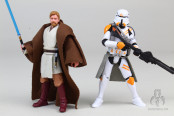
VC - Obi-Wan Kenobi (Utapau) & Airborne Clone Trooper (212th Battalion)
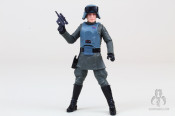
VC392 - General Veers (AT-AT Commander)
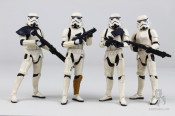
VC - Imperial Remnant Stormtrooper
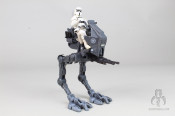
VC - Imperial Remnant AT-RT
VC386 - Marrok
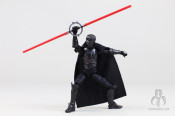
VC387 - Imperial Remnant AT-AT Driver
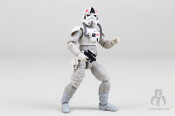
VC388 - IG-11 (Nevarro Marshal)

VC389 - Imperial Remnant Snowtrooper
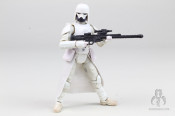
VC393 - Greedo

ADDITIONAL REVIEWS IN THE
PHOTO GALLERIES
PHOTO GALLERIES