SITE FEATURES


SPONSORS

FRIENDS






LATEST NEWS
The Science of Silence

THIS IS BULL****!...but I'm totally able to accept that other ridiculous thing.
Smithsonian.com interviewed Patrick Johnson, a Georgetown University physicist and author of the The Physics of Star Wars*
The article tackles Holdo's lightspeed ramming of Snoke's flagship. His comments don't shed any light on the concept that the maneuver may have rendered space naval warfare practically irrelevant. He also doesn't dive into the inability of Star Wars writers, George Lucas included, to properly differentiate between hyperspace and light speed (at least as we think we understand them).
Patrick Johnson instead focused on the "controversial" silence that accompanied the collision. It was reported that a few AMC theaters, reacting to customer complaints, posted a disclaimer warning patrons that the silence was an artistic choice by the filmakers, and not a technical glitch at the theater. The irony, of course, is that the silence is actually one of the rare scientifically accurate moments in Star Wars' many space scenes in which no sound is made. Johnson explains it simply:
Sound requires a medium to move from one place to another. And in space, there’s mostly nothing. So it doesn’t have a medium to move through, and it can’t propagate. Therefore, as the catchphrase for Alien was: ‘In space, no one can hear you scream.'
So while the vast majority of people understand that the silence was intentional and not an audio malfunction, it may be reasonable to assume that many people did NOT recognize the scientific accuracy of the choice (probably figuring that it was just really cool) and instead just assume that loud engine, explosion, and laser sounds in space are totally normal. He did touch on what Holdo's maneuver might look like to an observer on board a nearby ship:
That’s what it would be like for anybody watching that from afar. You watched the ship be there, and then not be there, and Snoke’s ship get cut in half. That is exactly what you would see from a different Star Destroyer.
Johnson, however, does speculate that a ship as large as Holdo's would more than likely "atomize" most of Snoke's ship, rather than just slice through, due to the "insanely high energy" of the collision.
Also not surprisingly, Johnson noted that fiery explosions in space would typically not be possible, since combustion requires oxygen. However, he conceded that some explosions, such as the ones that occurred on the surface of the First Order Dreadnought when Paige dropped the munitions from the Resistance bomber, would be possible, if not necessarily as dramatic. Theoretically, oxygen escaping from the breached hull could fuel some of the fire, but in his opinion, it wouldn't be as spectacular looking:
I would imagine that, due to the vacuum of space, once that first bomb blows a hole in the side of the ship, you would get a rush of oxygen coming out, and then a flame jet that would peter out pretty quickly. This is just me speculating.
The interview touches on one more mind-bending scene, which is Leia's survival in the vacuum of space. Setting aside the way the scene is shot - that is, the much maligned Mary Poppins-ish floating to safety - as well as the fictional and unknowable qualities of The Force, Johnson says that he felt Leia's survival was possible, even if only for a few seconds, if you assume that there was some kind of force field surrounding the still functioning flagship which kept the vacuum of space at bay. A field generated by the flagship itself, like a deflector shield could have insulated Leia briefly and prevented her immediate death.
Setting aside the science-defying properties of the Force—Johnson postulates that a Force field trapping air around the general would have prevented the near-instantaneous boiling away of all the water in her body due to depressurization, and her subsequent death by freezing—Johnson says the silence here is also on point.
The explanation for this last scene doesn't seem that strong, frankly. If Johnson sets aside the "science-defying" properties of The Force, then he's going out on a real limb by using a force field as a reason for Leia's survival, but it's better than nothing.
The article finishes with:
After all, while picking apart pedantic details can be an amusing exercise, he says, it is certainly inessential to one’s enjoyment of the work. “Ultimately,” he says, “they’re trying to make an entertaining piece of culture, rather than a 100-percent-accurate scientific document.”
The point as I see it, we fans are certainly ready, willing, and able to accept plenty of fantasical, unscientific, and even ridiculous aspects of the Star Wars universe, but we each have limits to our own ability or inclination to suspend disbelief.
Read more from Patrick Johnson about when Star Wars takes place, as well as how to build a real lightsaber (for Chris).
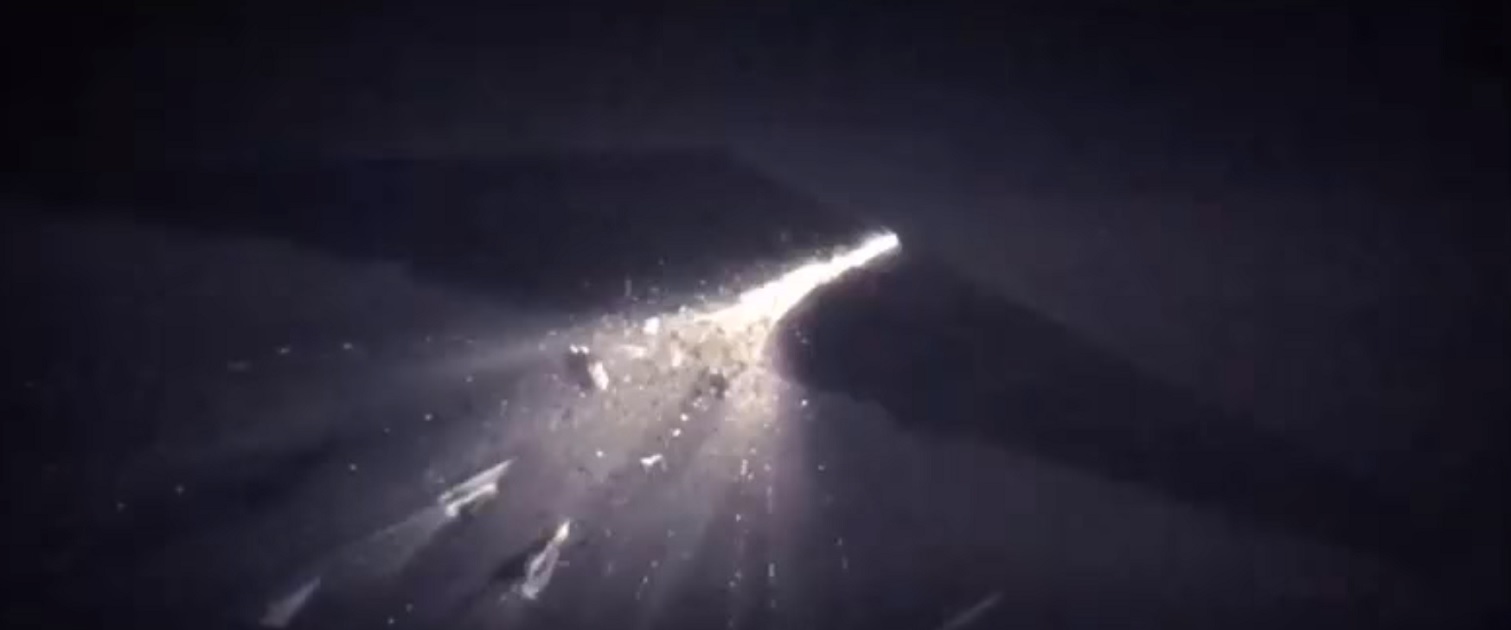
This may have been physically impossible, saga-shatteringly illogical, or both.
But it was still...AWESOME!
But it was still...AWESOME!
*Sponsored Amazon Link.
comments powered by Disqus
LATEST PHOTO GALLERIES
VC400 - Zeb Orrelios (New Republic Pilot)

VC - Orray & Geonosian Picador

VC - Super Battle Droid & Battle Droids (Geonosis)

VC397 - Baze Malbus
VC394 - Imperial Snowtrooper Commander

VC - Obi-Wan Kenobi (Utapau) & Airborne Clone Trooper (212th Battalion)

VC392 - General Veers (AT-AT Commander)

VC - Imperial Remnant Stormtrooper
VC - Imperial Remnant AT-RT
VC386 - Marrok
ADDITIONAL REVIEWS IN THE
PHOTO GALLERIES
PHOTO GALLERIES